Whose drain is it? Understanding drain responsibility in the UK
One of the most common questions when a drain blocks or fails isn't "how much will it cost" but "is this actually my problem to fix" — and the answer genuinely depends on exactly where the affected section of pipe sits. Getting this wrong can mean either paying for repairs a water company should be covering, or waiting on a water company that isn't actually responsible for your specific pipe.
The current system dates from a significant change on 1 October 2011, when the majority of private sewers and lateral drains in England and Wales that were already connected to the public sewer network by 1 July 2011 transferred into public ownership, becoming the responsibility of the relevant local water and sewerage company rather than private individuals. This was a genuinely large shift — millions of households effectively had a section of pipe they'd previously been responsible for become the water company's problem overnight, though the change wasn't always well understood by homeowners at the time and still causes confusion today.
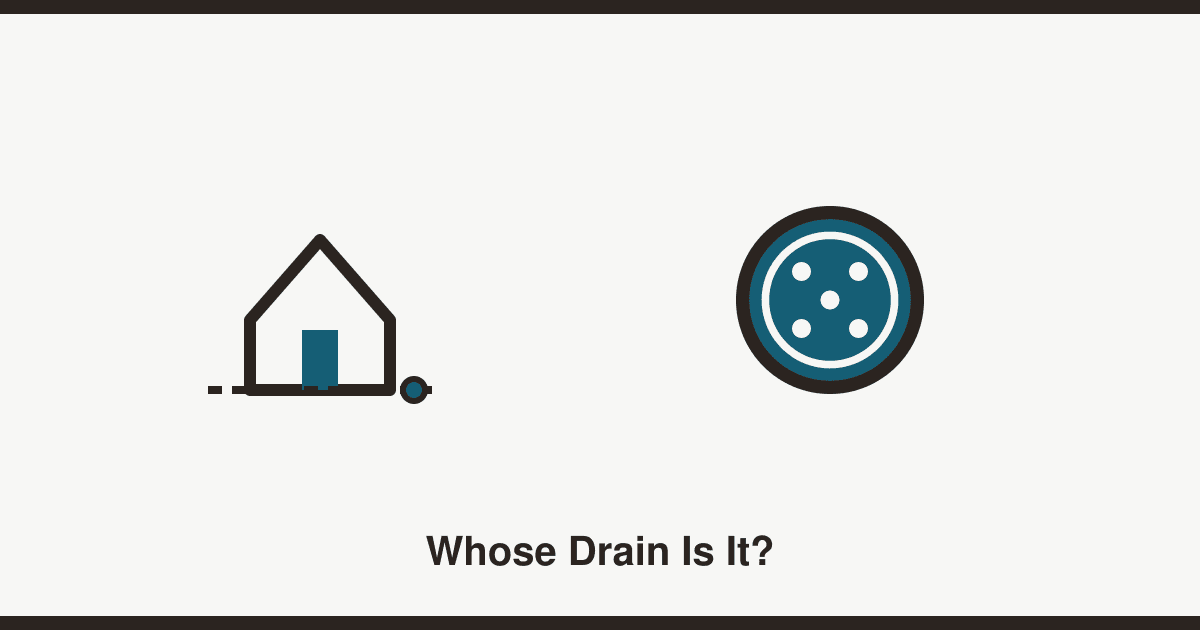
Understanding the different categories matters, because each one has a different answer to "who fixes it." A private drain is the pipework within your own property's boundary, serving your property alone — this remains your responsibility to maintain and clear if it blocks, regardless of the 2011 transfer. A lateral drain is the section running from your property boundary, typically under the pavement or road, to where it connects to the public sewer; if this drain existed and was connected before the 1 July 2011 cut-off, it's now generally the water company's responsibility rather than yours. A shared drain — one serving your property and at least one neighbour's before reaching the public sewer — is commonly the water company's responsibility once it's past the point where it starts serving multiple properties, though the section serving only your own property up to that shared point remains yours. And a public sewer, collecting wastewater from a number of properties, is overwhelmingly publicly owned and is the water company's responsibility, though a small number of older private sewers still exist.
There's an important exception worth knowing: any new private drain or lateral drain constructed after the 2011 cut-off remains the responsibility of the property owner or developer who built it, unless it's been through a formal Section 104 adoption agreement with the water company — something that's now standard practice for new housing developments, but isn't automatic for a drain someone lays themselves. It's also worth knowing that even where a lateral drain has transferred to the water company, you remain responsible for the pipework between your property and the point where it joins that transferred drain — the transfer doesn't extend responsibility right up to your external wall.
In practice, this means the first sensible step when a drain blocks or shows signs of a defect is working out roughly where the problem sits, since that determines who to actually call. If it's clearly within your own property boundary, it's your drain and your cost to fix. If it's out in the road or pavement, or if a CCTV survey shows the defect sits well beyond your boundary, it's worth contacting your local water company first — most operate a free service for blockages affecting a lateral drain or public sewer, and turning to a private drainage contractor for something the water company should be covering means paying unnecessarily. Where it's genuinely unclear, a private drainage company carrying out an initial CCTV survey can usually identify roughly where a defect sits relative to the property boundary, which is often enough to work out who's actually responsible before committing to a full repair.
If there's a genuine dispute about responsibility — for instance, a defect close to the boundary where it's not obvious which side of the transfer line it falls — Citizens Advice and the relevant water company's own customer service team are the recommended starting points, rather than either party simply assuming responsibility or refusing to act. This article is general information, not legal advice, and specific disputes should be raised with the relevant water company or an appropriate advice service.
Frequently asked questions
On 1 October 2011, the majority of private sewers and lateral drains in England and Wales that were already connected to the public sewer by 1 July 2011 transferred into public ownership, becoming the responsibility of the local water and sewerage company rather than private homeowners.
Yes — a private drain within your own property boundary, serving only your property, remains your responsibility to maintain and clear if it blocks, regardless of the 2011 transfer of lateral and shared drains.
If it is a lateral drain that was connected to the public sewer before 1 July 2011, it is now generally the responsibility of the local water and sewerage company, not the homeowner — though you remain responsible for the pipework between your property and where it joins that drain.
No — a private drain or lateral drain built after the 2011 cut-off remains the responsibility of the property owner or developer unless it has gone through a formal Section 104 adoption agreement with the water company.